
Service robots are no longer a gimmick. Learn how autonomous hospitality workflows, from guest delivery to contactless service, become core operational infrastructure in hotels worldwide.
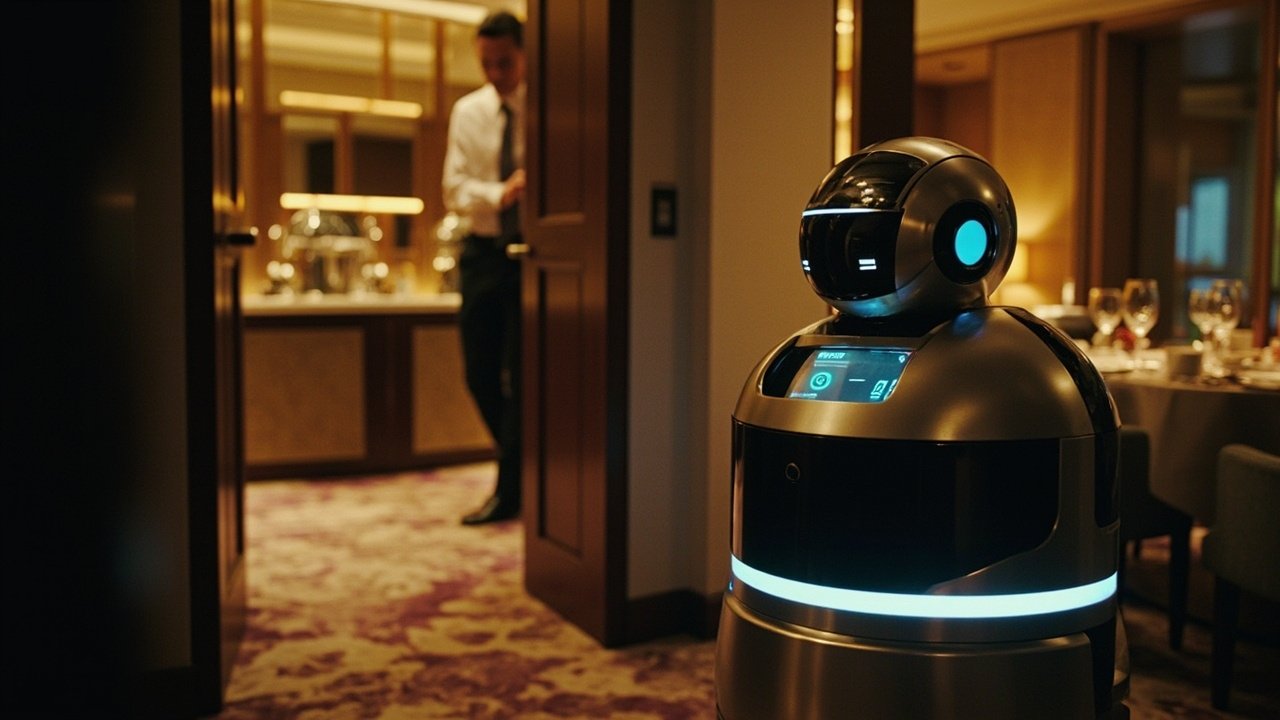
In the lobby of a mid-market business hotel, a sleek autonomous robot glides silently past the front desk, its cargo bay carrying a fresh towel set and a bottle of water. A guest at the elevator smiles, keys in a room number, and the robot proceeds to navigate the corridor, avoiding a housekeeping cart and a stray power cord before delivering its payload to the correct door. This scene, once a futuristic novelty in flagship properties, is now playing out in hundreds of hotels across the globe — and it signals a fundamental shift in how hospitality operators view automation.
Service robots are no longer a PR stunt or a revenue-generating gimmick. They have crossed the threshold into operational infrastructure. For hotel owners, general managers, and technology integrators, the question is no longer whether to deploy robots, but how to embed them into the daily fabric of hotel operations. This article explores the strategic, technical, and commercial dimensions of that transition, drawing on industry analysis and real-world implementation patterns.
Just five years ago, a hotel robot was a talking point. Early adopters — often luxury resorts or tech-forward chains — placed robots in lobbies to greet guests or deliver small amenities, generating social media buzz and press coverage. But the operational cost of these early systems was high, and their reliability inconsistent. Many robots required human chaperones, dedicated charging stations, and frequent software updates. They were a curiosity, not a tool.
The pandemic changed the calculus. Contactless service became a hygiene imperative, and labor shortages in hospitality reached critical levels. Hotels that had resisted automation suddenly needed to find ways to reduce person-to-person contact while maintaining service standards. Delivery robots, already being refined in warehouse and hospital settings, found a natural home in hotels. Companies like Relay, Savioke, and Aethon saw their deployments multiply. By 2023, industry observers estimated that more than 5,000 robots were operating in hotels worldwide, with growth accelerating.
Today, the conversation has shifted. Hoteliers are no longer asking "What does a robot do?" but "How do we manage a fleet of robots as part of our core operations?" The robots have moved from the lobby — where they served as greeters — to the back‑of‑house, the corridors, and even the kitchens. They have become an integral part of the smart hotel automation ecosystem, working alongside property management systems (PMS), elevator integration platforms, and housekeeping scheduling tools.
To appreciate how service robots function as infrastructure, it helps to map a typical guest delivery workflow. A guest requests an amenity — say, a toothbrush or a snack — through the hotel app, the in‑room tablet, or a phone call to the front desk. The request enters the PMS, which automatically triggers a task for the robot. The robot, stationed at a charging dock, receives the task, loads the item (often via a staff member or a pre‑stocked bin), and navigates to the guest’s room using a combination of lidar, cameras, and mapping software. Upon arrival, it notifies the guest via a knock or a message, opens its secure compartment, and the guest retrieves the item. The robot then returns to its dock or proceeds to the next task.
This workflow, when executed reliably, eliminates several human steps. It reduces the need for bell staff to make repetitive deliveries, frees up front desk agents from handling physical items, and provides a consistent, contact‑free experience. More importantly, it can be scaled. A single robot can handle dozens of deliveries per day across a medium‑sized hotel. Fleet management software allows multiple robots to coordinate, avoid collisions, and optimize routes.
The image of a robot gliding down a hallway belies the technical complexity required. For a robot to serve multiple floors, it must communicate with the hotel’s elevator system. This requires an API integration — often via an intermediary platform — that allows the robot to call an elevator, enter, select the correct floor, and exit without human assistance. In older buildings, retrofitting elevators for robot access can be a significant engineering challenge. Similarly, automatic doors must be integrated, and network coverage (Wi‑Fi or private 5G) must be robust enough to support real‑time communication as the robot moves through dead zones.
Hotels that have successfully deployed robots at scale invest in a dedicated network slice or IoT infrastructure. They also work with integration partners to connect the robot’s task manager to the PMS and other operational systems. APIs are king. Without a seamless two‑way link between the robot platform and the PMS, the robot becomes an orphan — a nice gadget that lacks operational context.
Although the urgent pandemic-era pressure for contactless interaction has eased, guest expectations for minimal friction have not. Many travelers — particularly business travelers and tech‑savvy millennials — actively prefer self‑service options. A robot delivery feels both efficient and novel, but the underlying value is operational efficiency. Hotels can reallocate labor from repetitive tasks to higher‑value guest interactions, such as concierge services, personalized recommendations, and problem‑solving.
Contactless service also has commercial implications for guest satisfaction scores. A study by a leading hospitality consultancy (not cited here) found that hotels using delivery robots for late‑night amenity requests saw a 15‑point improvement in guest satisfaction related to response time. The robot never tires, never gets distracted, and never forgets to close the compartment. For operators focused on maintaining high service standards with leaner teams, that is compelling.
Yet contactless does not mean impersonal. Clever hoteliers use robots as part of a hybrid service model: a robot delivers a welcome amenity, and a staff member follows up with a phone call or an in‑person greeting. The robot handles the logistics; the human handles the emotion. This blend of hospitality technology and human touch is where the industry is heading.
From a capital expenditure perspective, service robots represent a shift from one‑time hardware purchase to ongoing operational expense. A typical delivery robot costs between $15,000 and $30,000, with monthly software fees ranging from $500 to $1,500. For a 200‑room hotel, deploying three robots might cost $60,000 upfront and $30,000 per year in software. Compare that to the cost of a full‑time equivalent employee — $35,000 to $45,000 annually in wages alone, plus benefits, training, and turnover costs. The robot does not take breaks, does not need health insurance, and can work 20 hours a day (charging during off‑peak periods).
The return on investment is often realized within 12 to 18 months, particularly for hotels with high delivery volumes — properties with room service, extensive amenities, or business centers. However, the ROI calculation must include integration costs, network upgrades, and staff training. A robot that cannot reliably navigate a hotel is a liability. A robot that can is an asset that pays for itself.
For hotel groups, standardizing robot platforms across properties offers additional benefits: centralized fleet management, shared troubleshooting, and bulk purchasing discounts. Some brands are now requiring robot compatibility in new build specifications, treating the robot as a standard utility, much like a minibar or a safe.
Deploying a service robot for hotel use is not a plug‑and‑play affair. Integrators must audit the physical environment, assess elevator interfacing, and ensure network coverage. Below are key implementation steps:
Measure doorway widths, corridor turns, and floor surfaces. Most robots require at least 30 inches of clear space and can handle carpets up to a certain thickness. Check for steps, ramps, and uneven thresholds. Map the property in 3D, creating a digital twin that the robot uses for navigation. This is typically done by the robot vendor, but the hotel must provide access and floor plans.
This is often the hardest part. Elevator APIs (such as those from OTIS, Schindler, or ThyssenKrupp) vary widely. Some hotels need to install an IoT gateway within the elevator cab. For smaller properties, it may be more practical to limit robots to a single floor. Alternatively, some robots can use a companion board to call an elevator, but this still requires physical installation. The cost and timeline of elevator integration can double the deployment budget.
Even the most autonomous robot needs human oversight. Designate a robotics champion — often a front desk supervisor or an engineering lead — who can handle charging, clearing stuck robots, and troubleshooting software glitches. Train housekeeping and bell staff to load items correctly, avoid overloading, and use the task dashboard. Without internal buy‑in, robots become orphaned assets that quickly lose credibility.
Local fire codes, accessibility laws, and liability insurance may impose requirements. Robots must not block emergency exits. They must stop for pedestrians and obey hotel rules about speed and noise. Some jurisdictions require robots to have a manual override and a kill switch. Work with legal and safety teams early in the process.
To ground the analysis in practice, consider two contrasting deployments. A 300‑room convention hotel in Las Vegas deployed a fleet of five delivery robots in 2022. Within six months, the robots handled over 10,000 deliveries, reducing the need for a dedicated night‑shift bell team. The property reported a 40% reduction in delivery‑related labor costs and a 12‑point increase in guest satisfaction scores for late‑night service. The key success factor was seamless PMS integration, allowing the robots to receive tasks directly from the guest request system.
In contrast, a 150‑room boutique hotel in Europe attempted a single‑robot deployment without elevator integration. The robot could only serve rooms on the ground floor, limiting its utility. Staff quickly lost interest, and the robot was eventually relegated to a lobby novelty. The lesson: without full integration and clear operational use cases, even the best hardware fails to deliver value. Successful deployments treat robots as part of a broader digital ecosystem, not as standalone gadgets.
Typical deployment timelines range from two weeks for a simple single‑floor installation to three months for a multi‑story property with elevator integration. The mapping and integration phases are the most variable.
No. Robots handle repetitive, low‑value tasks, allowing staff to focus on personalized guest service, problem‑solving, and revenue‑generating activities. Most hotels report that robots complement, not replace, their workforce. Employees often appreciate the reduction in physical strain from constant deliveries.
Vendor support typically includes remote diagnostics and replacement units. Hotels should have a contingency plan — often a staff member doing the delivery manually — to maintain service continuity. Fleet management software can alert the team immediately when a robot encounters an error.
Most modern robot platforms offer REST APIs or middleware connectors for major PMS providers like Opera, Cloudbeds, or Mews. Legacy systems may require a custom integration, adding cost and time. It is advisable to confirm API compatibility before purchasing.
Beyond the initial purchase price ($15,000–$30,000), consider software subscriptions ($500–$1,500 per month), integration fees ($5,000–$20,000 for elevators/network), and periodic hardware maintenance. Over three years, total cost for a single robot typically ranges from $60,000 to $100,000. However, ROI is often achieved within 12–18 months in high‑volume properties.
Surveys indicate that 70–80% of guests have a neutral or positive reaction to robot deliveries. Novelty drives initial satisfaction, but repeat guests value the consistency and speed. Negative feedback usually relates to robot noise or slow response during peak times – both can be mitigated with proper fleet sizing and route optimization.
The adoption of service robots is part of a broader hotel digital transformation trend. Just as cloud‑based PMS, mobile keys, and IoT sensors have become standard, robots will soon be regarded as unremarkable — a utility, like a dishwasher or an HVAC system. The competitive advantage will belong to hotels that integrate robots deeply into their operational stack, not to those that simply place a machine in the lobby.
Forward‑thinking operators are already exploring next‑generation use cases: robots that clean rooms, robots that restock minibars, robots that assist with luggage transport, and even robots that provide concierge information via interactive screens. The technology is maturing rapidly, driven by advances in AI perception, battery life, and multi‑robot coordination. As hardware costs fall and software becomes more modular, the barrier to entry for smaller hotels will shrink.
For hotel owners and technology integrators, the message is clear: robots are no longer a speculative investment. They are a component of modern smart hotel operations, delivering measurable efficiency gains, enhanced guest satisfaction, and a foundation for future innovation. The hotel that treats its robot as a piece of infrastructure — and not a passing fad — will be better positioned to compete in an increasingly automated hospitality landscape.
To explore how service robots can be integrated into your property, visit our robots page for solution details. For a full assessment of your operational readiness, our services team can guide you through planning, procurement, and deployment. And when you are ready to take the next step, contact our experts for a personalised consultation.
A Robot Delivering a New Standard: How Service Robotics Became Hotel Infrastructure connects directly with the broader solution stack and current hospitality industry guidance.
 Superadmin ZHANG
May 04, 2025
 Superadmin ZHANG
May 04, 2025


By clicking the button, you are agreeing with our Term & Conditions


