
Service robots are no longer a gimmick. They are becoming essential infrastructure for guest delivery, disinfection, and workflow automation. Discover how hotels are integrating autonomous systems into daily operations.

In the softly lit lobby of a midscale urban hotel, a sleek autonomous robot glides across the marble floor. It carries a tray of fresh towels, a bottle of water, and a small welcome note. The robot pauses beside a guest who has just checked in, emits a polite chime, and waits. The guest takes the items with a nod of appreciation, and the robot continues its journey toward the next service request. Scenes like this are no longer the stuff of futuristic fantasy or experimental tech showcases. They have become routine.
What was once a novelty attraction—a cute robotic butler to amuse guests and generate social media buzz—has evolved into a core operational tool. Service robots are now quietly assuming tasks that used to burden human staff, freeing up employees for higher-value interactions and allowing hotels to deliver consistent, contactless service. This shift is not just about cutting costs or chasing headlines; it is about reimagining the hotel as a fully integrated, technology-enabled environment. For hotel owners, operators, and technology integrators, the question is no longer whether to deploy robots, but how to embed them seamlessly into daily workflows.
The early days of hotel robotics were marked by spectacle. A robot concierge here, a delivery droid there—each rollout was accompanied by press releases and viral videos. Guests delighted in the novelty, and hotels earned valuable marketing mileage. But the operational impact was often superficial. Robots were siloed, limited to a single task, and required constant human supervision. They were curiosities, not infrastructure.
The pandemic changed everything. When social distancing became the norm, contactless service shifted from a differentiator to a prerequisite. Hotels that had already invested in service robots for hotel delivery and disinfection found themselves ahead of the curve. Those that had not scrambled to adapt. Overnight, the same robots that had once been dismissed as gimmicks became essential tools for safe, efficient operations.
Today, the conversation has matured. Hoteliers view robots not as standalone gadgets but as components of a broader digital ecosystem. They integrate with property management systems, coordinate with elevator banks, and communicate with guest mobile apps. The technology has become reliable enough to run autonomously for hours, mapping complex floor plans and avoiding obstacles. The novelty has worn off, and in its place, a proven operational asset has emerged.
For hotel owners evaluating capital investments, the business case for service robots has strengthened considerably. The return on investment extends beyond direct labor savings. Robots reduce employee fatigue by handling repetitive, physically demanding tasks such as delivering luggage, room service, or amenities across sprawling properties. They allow human staff to focus on guest engagement, problem-solving, and personalized service—the very qualities that drive loyalty and repeat bookings.
Guest satisfaction scores also benefit. In a recent industry survey, hotels that deployed autonomous delivery robots reported higher ratings for speed of service and overall convenience. Guests appreciate not having to wait for housekeeping or front desk staff for simple requests. A robot can fulfill a request for extra pillows in under five minutes, without requiring a human to leave a station or interrupt another task.
Beyond direct service, robots generate valuable operational data. Every delivery, every route, every interaction becomes a data point that can be analyzed to optimize staffing levels, reduce wait times, and identify bottlenecks in the workflow. This data-driven approach to hotel management is a cornerstone of hospitality technology transformation. When combined with sensors and analytics, robots become instruments of continuous improvement.
Labor accounts for the largest expense in hotel operations, and the industry has faced chronic staffing shortages. Service robots offer a scalable solution to augment the workforce. A single robot can make dozens of deliveries per shift, covering distances that would require multiple staff members. The cost of a robot, while significant upfront, amortizes over its lifespan of several years. When factoring in reduced turnover, lower training costs, and the ability to redeploy human talent where it matters most, the financials become compelling.
Moreover, robots are tireless. They do not require breaks, sick leave, or shift differentials. They work 24/7 if needed, handling late-night requests that would otherwise go unfulfilled. This availability enhances the guest experience, especially for business travelers and international guests who may need service outside standard hours.
Bringing service robots into a hotel is not as simple as unpacking a device and turning it on. Successful deployment requires careful planning across several dimensions: physical infrastructure, software integration, staff training, and guest communication.
Before a robot can navigate a hotel autonomously, the environment must be mapped in high detail. This involves scanning corridors, identifying doorways, noting carpet transitions, and marking no-go zones such as stairwells or uneven surfaces. Many modern robots use lidar and vision-based simultaneous localization and mapping (SLAM) to build and update maps continuously. Hotels with complex layouts, multiple wings, or heavy furniture may need to adjust their floor plans to create clear corridors for robot travel.
Elevator integration is one of the most critical elements. Robots must communicate with the elevator control system to call and board the right car. This often requires installing an Internet-of-Things (IoT) bridge or a dedicated API. Properties that invest in this integration early find their robots can serve multiple floors without human assistance.
For a robot to truly become part of the hotel's operational backbone, it must integrate with the property management system (PMS), the guest room app, and the housekeeping dispatch system. When a guest requests fresh towels via the mobile app, the PMS should automatically create a task that a robot can pick up. The robot's status should be visible to front desk staff so they can monitor progress. This level of automation requires middleware or a platform that orchestrates workflows across devices.
Hotels may also need to integrate with their existing key card system so robots can access secured areas. Some properties have created special docking stations where robots recharge and receive new assignments without human intervention.
Even the most advanced robot will fail if the staff does not trust it or know how to work with it. Training should extend beyond the engineering team to include every employee who might encounter the robot: front desk agents, bell staff, housekeeping, and even security. Staff should understand what tasks the robot handles, how to intervene if it goes off course, and how to assist guests in using the robot's interface.
Change management is equally important. Some employees may view robots as a threat to their jobs. It is crucial to frame robots as tools that enhance human roles, not replace them. When staff see that robots handle tedious deliveries and they can focus on guest relationships, resistance often turns to advocacy.
Quantifying the return on investment for service robots requires a multi-lens approach. Hotel owners should calculate not only direct labor savings but also indirect benefits such as reduced guest complaints, faster service turnaround, and increased brand differentiation. A typical mid-scale property with 150 rooms might deploy two delivery robots and one disinfection robot at a total capital cost of $90,000. Over a five-year lifespan, the robots can replace the equivalent of three full-time employees focused on amenity runs and cleaning tasks. With average annual labor costs of $35,000 per employee (including benefits), the annual savings reach $105,000, yielding a payback period of under one year.
Additional revenue opportunities arise from the ability to offer premium services enabled by robots, such as contactless late-night delivery or express check-out baggage handling. Some hotels have even introduced robot-led tours or robot partner programs with local businesses, creating new marketing channels. The data collected by robots also helps optimize room assignment and housekeeping schedules, further trimming operational waste.
When presenting the business case to stakeholders, include an analysis of employee retention. Properties that automate repetitive tasks often see lower turnover because staff feel their work is more meaningful. This reduction in recruitment and training costs can add another 2-3% to the net margin. Combined with guest satisfaction gains that drive repeat bookings, the strategic value of robotics becomes undeniable.
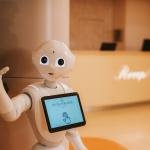
In the image that inspired this article, a hotel robot is likely engaged in either disinfection or delivery—often both. The pandemic cemented the need for automated cleaning protocols, and many service robots now carry ultraviolet (UV) lamps or electrostatic sprayers. These disinfection robots can sanitize guest rooms, lobbies, and meeting spaces between occupants, reducing the chemical exposure of human cleaners and ensuring thorough coverage.
Combining delivery with disinfection creates a powerful use case. A robot that delivers amenities can also disinfect its own tray after each use, or it can alternate between service runs and scheduled cleaning rounds. This multifunctionality maximizes the return on the robot investment. Hotels that deploy dual-purpose robots find they can address health concerns and guest requests without adding headcount.
Contactless service has become an expectation, not a perk. Guests want to minimize physical touchpoints, from check-in to room entry to service delivery. Service robots serve as a visible symbol of a hotel's commitment to hygiene and innovation. They demonstrate that the property is actively investing in smart hotel automation to provide a safer, more convenient stay.
The next frontier for service robotics in hotels is the orchestration of autonomous workflows. Rather than individual robots completing isolated tasks, fleets of robots will coordinate with each other and with other smart building systems. Imagine a scenario where a guest's checkout triggers a room cleaning request. A disinfection robot enters first, followed by a housekeeping robot that restocks mini-bars and linens. Meanwhile, a delivery robot brings a fresh coffee to the new guest waiting in the lobby. All of this happens in parallel, managed by a central automation platform.
Predictive maintenance and self-diagnosing robots will further reduce downtime. When a robot detects a wheel imbalance or low battery, it will automatically navigate to a charging station and report its status to the maintenance team. Machine learning algorithms will optimize routes based on real-time demand patterns, ensuring that robots are deployed where they are needed most.
Emerging business models like Robot-as-a-Service (RaaS) are lowering the barrier to entry. Instead of purchasing robots outright, hotels can lease them on a monthly subscription that includes maintenance, software updates, and monitoring. This turns a capital expense into an operational one and allows properties to scale their fleet up or down during peak seasons. As the ecosystem matures, interoperability between different brands of robots and systems will become a priority. Open standards and APIs will allow hotels to mix and match robots from multiple vendors, creating a flexible, best-of-breed infrastructure. The hotels that plan for this future today will be best positioned to adapt as technology advances.
Integration complexity varies by vendor and existing infrastructure. However, most modern service robots come with open APIs and support for common hotel systems like PMS and elevator controls. A thorough assessment by a technology partner can identify any gaps before deployment.
Robots are designed with multiple safety features, including emergency stop buttons, collision sensors, and fail-safe navigation. In the event of a malfunction, the robot stops and alerts the central monitoring system. Hotel staff can then manually move the robot to a service area. Most vendors offer remote diagnostic support.
Adoption rates are high, especially when the robot is integrated with the hotel’s mobile app or guest-facing technology. Guests appreciate the speed and convenience. Some may initially be shy, but once they see others using the robot, usage tends to spread quickly.
Most commercial service robots are designed for single-floor or elevator-enabled movement. They cannot climb stairs. For properties with steps, additional infill ramps or alternative routing may be needed. Manufacturers recommend pre-mapping all accessible areas to ensure safe navigation.
With proper maintenance, a service robot can operate effectively for three to five years. Battery life degrades over time, but batteries are replaceable. Software updates can extend functionality and keep the robot relevant as new features become available.
Most indoor service robots are not weather-resistant. Outdoor deployments require specialized models with weatherproofing and rugged wheels. Some hotels use separate outdoor robots for poolside delivery or luggage carting, but indoor models should be kept inside to avoid damage.
Robots are programmed to yield to humans and navigate around obstacles. During high-traffic periods, the fleet management system can adjust routes to avoid busy areas, reduce speed, or temporarily pause operations. Many robots have adaptive cruise control similar to autonomous vehicles.
A service robot consumes roughly the same power as a medium-sized vacuum cleaner—about 200–300 watts while moving. Charging stations are typically installed in utility closets, and the robot self-docks when its battery falls below a threshold. Energy costs are minimal, often under $50 per year per robot.
Service robots have crossed the threshold from experimental gadget to reliable hotel infrastructure. They offer tangible benefits in labor efficiency, guest satisfaction, and operational agility. For hotel owners and operators, the decision to invest in automation is no longer a futuristic gamble—it is a strategic necessity in an industry that demands continuous improvement.
The key is to approach deployment with a clear plan: map your property, integrate with existing systems, train your staff, and choose robots that align with your guest journey. Start with a pilot in a single corridor or service area, measure results, and then scale. The hotels that treat robots as a permanent part of their technology stack will gain a competitive edge in both cost structure and guest experience.
Are you ready to make service robots part of your hotel's operational backbone? Contact our team today to explore how smart hotel automation solutions can be tailored to your property.
How Service Robots Are Shifting from Novelty to Operational Infrastructure in Hotels connects directly with the broader solution stack and current hospitality industry guidance.
 Superadmin ZHANG
May 04, 2025
 Superadmin ZHANG
May 04, 2025


By clicking the button, you are agreeing with our Term & Conditions


